
By Holly Dagres
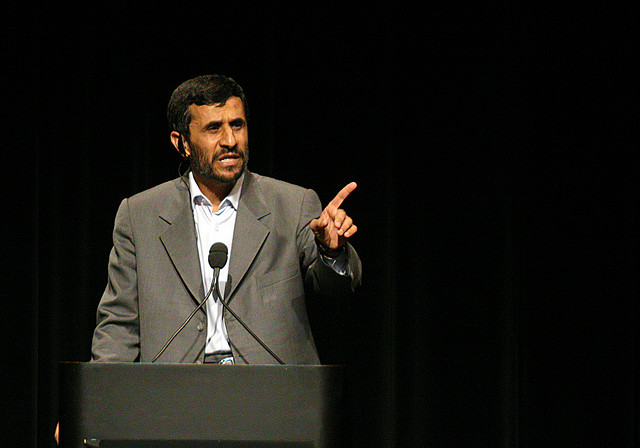
A few weeks ago proved interesting for Iranian politics as internet rumors circulated that President Mahmoud Ahmadinejad would be resigning from his post as President of the Islamic Republic. Although this was not the case – for the time being – an apparent change in Iran’s political terrain has become eminent.
Since the 2009 Green Revolution, the political climate of Iran is full of chasms. Publicly recognized disputes between the Supreme Leader Ayatollah Sayyed Ali Khamenei and President Ahmadinejad have raised many questions about Iran’s uncertain future. Recent allegations of sorcery seem to point towards a more profound history of tension between two groups: the President and his inner circle versus the Supreme Leader and the hard-liners surrounding him.
On Sunday, Ahmadinejad returned to his duties after an eleven-day, self-imposed walkout over Khamenei’s decision to reinstate the intelligence minister, Heidar Moslehi, who the President had initially asked to step down.
Around the same time, allies of President Ahmadinejad, including his Chief of Staff, Esfandiar Rahim Mashaei, were placed in custody and accused of being “magicians” and invoking djinns. This allegation was partially developed because of an Iranian documentary, The Reappearance is Near. The storyline is based on the Hidden Imam Mahdi who went into occultation and is said to return before the apocalypse; an ideology similar to Christian fundamentalists’ anticipation of the second coming of Christ. The documentary makes an overt declaration that the Ahmadinejad is an embodiment of Shu’ayb bin Salih, one of the figures who will accompany the Hidden Imam upon his revisit. This statement puts Ahmadinejad, well known for his obsession with the Hidden Imam, on a spiritually higher level than the clerics in the Guardian Council as well as the Supreme Leader. Hard-liners share a belief that Mahdi’s return is unpredictable and accuse Mashaei and other followers of the President of iconoclasm and spreading superstition.
This long forming rift between the Supreme Leader and President became apparent right around the endorsement of President Ahmadinejad’s second term. After the controversial elections in 2009, Ahamdinejad was permitted only to give Khamenei a shoulder kiss rather than an embrace as has been done in the past. This unusual body language became a precursor to public displays of tension.
What can be understood is the façade of unity put up by the two was merely a show in a country divided because of the post-election protests and decisions made by Ahmadinejad in his new cabinet. Right before his endorsement, President Ahmadinejad defied the Supreme leader with his choice for Vice President, Esfandiar Rahim Mashaei. This became a major blow to conservatives, especially due to Mashaei’s comments in 2008 when he claimed, “No nation in the world is our enemy. Today, Iran is friends with the people of America and Israel and this is an honor.” At the time, he was also in charge of tourism and cultural heritage in Iran. Despite the controversy, Mashaei would become President Ahmadinejad’s Chief of Staff.
The Islamic Republic’s first President, Abulhassan Banisadr went through similar clashes that eventually lead to his impeachment by the ‘majles’ or Iranian parliament. His condemnation of censorship, human rights violations, torture, as well as Khomeini’s leadership – albeit different in ideologies – eventually lead to his exile. It is unlikely this will be the case for President Mahmoud Ahmadinejad who is revered for being Khamenei’s boy, and to not show an obvious loss of strength in the Iranian regime. Making President Ahmadinejad a scapegoat for Iran’s problems could prove to be fatal, as the small sign of weakness in the regime could potentially invoke protests in the street.
What remains clear is that President Mahmoud Ahmadinejad has one of three choices: he could step down as President of the Islamic Republic, he could swallow his pride and remain in office, or he could go head to head with the Supreme Leader and face the consequences. Either way, this is an interesting time for Iran. Tehran will be watched closely to see what happens next, especially in a region experiencing such instability.
Holly Dagres is a Foreign Policy Analyst with a degree in Political Science and French from UCLA. Originally from Los Angeles, California, she spent her teen years in Tehran, Iran. Holly is a frequent contributor to The Professional Express among other publications.
Above Picture Used with Permission:
 by Daniella Zalcman


8 comments
naturally like your website but you have to check the spelling on quite a few of your posts. Many of them are rife with spelling problems and I find it very bothersome to tell the truth nevertheless I will surely come back again.
Through my investigation, shopping for electronic devices online can for sure be expensive, but there are some guidelines that you can use to help you get the best things. There are always ways to uncover discount discounts that could help make one to ge thet best consumer electronics products at the smallest prices. Good blog post.
WONDERFUL Post.thanks for share..more wait .. ?
Do you have a spam issue on this blog; I also am a blogger, and I was wanting to know your situation; many of us have created some nice practices and we are looking to trade techniques with other folks, be sure to shoot me an e-mail if interested.
I’m really enjoying the theme/design of your blog. Do you ever run into any browser compatibility issues? A few of my blog visitors have complained about my blog not working correctly in Explorer but looks great in Firefox. Do you have any solutions to help fix this issue?
Hmm is anyone else encountering problems with the pictures on this blog loading? I’m trying to determine if its a problem on my end or if it’s the blog. Any feed-back would be greatly appreciated.
very good submit, i definitely love this website, carry on it
I have witnessed that fees for internet degree pros tend to be a fantastic value. For example a full College Degree in Communication with the University of Phoenix Online consists of Sixty credits with $515/credit or $30,900. Also American Intercontinental University Online offers a Bachelors of Business Administration with a full course requirement of 180 units and a cost of $30,560. Online learning has made taking your education been so detailed more than before because you can earn your current degree through the comfort of your home and when you finish working. Thanks for other tips I have really learned through your website.