
by Rujuta Gandhi
Editor
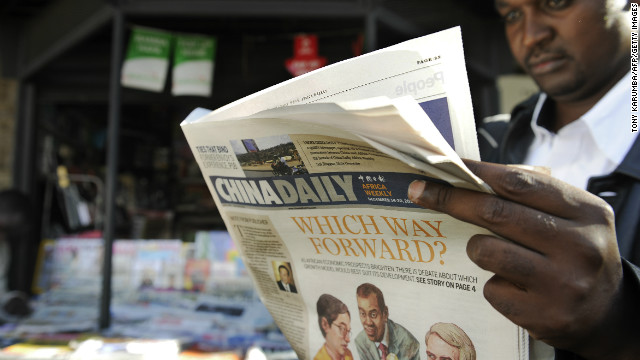
First, China constructed multibillion-dollar cities, or ghost cities, dubbed as such because of the empty high-rises, parking lots, and playgrounds. Then, it “gifted” the $200 billion African Union headquarters. Now, China Daily, a global Chinese newspaper, blesses the continent with its Africa edition. Why is China burdening itself with a responsibility to develop Africa, and why expand its media presence? Perhaps the communist nation hopes to find amity by extending a hand of friendship—a gesture riddled with soft power ambitions.
Slowly developing Chinese media in Africa is a geostrategic move against western media, which already hold the upper hand by bashing Chinese involvement throughout the continent. Since 2008, these sources have increasingly been exposing China’s harmful role—its contribution to the genocide in Darfur is only one example. Non-media sources, such as the book China and Africa: A Century of Engagement, also contribute to this condemnation. Therefore, by establishing a media presence, China hopes to combat what it perceives as “misrepresentations” of its purpose in Africa. Such misconceptions could harm future economic ties and political support in Sino-African relations. Consequently, China is using the media as a tool of soft power.
This power play will help protect China’s future in both the long and short term. In the long term, it is likely that they aim to secure their economic presence and ability to extract natural resources or to resettle their burgeoning population, among other motives. However, in the short term, the government is taking swift action to survive on the new battlefield of state-financed satellite television news, a notion voiced publicly by former U.S. Secretary of State Hillary Clinton. Already, foreign news services, such as France24 and Russia Today, have moved their metaphorical pawns, bishops, and knights to gain ground and mitigate negative images of their respective countries. China is merely following suit.
Xinhua News Agency, China’s state-owned press, established its presence in Africa beginning in the 1970s and now operates more than 20 bureaus continent-wide. In 2011, it began broadcasting a subsidiary television station, CNC World. A year later, the state-run but market-funded Chinese Central Television (CCTV) rooted its headquarters in Nairobi, Kenya. Most recently (and another year later), China Daily launched its Africa edition. However, both broadcasting companies incorporate heavy biases in favor of China; they highlight social and cultural topics and positive narratives while avoiding controversial ones, including political issues. In the April 12–18, 2013 weekly edition, the article “Strong China-Africa Cooperation Pays,” endeavored to convince Africans that, with China’s aid, Africa can be an “Asian tiger,” while “Good Hair Days” discussed the relationship between women’s hairstyles and social change in China. Furthermore, in an attempt to gain an upper hand on the U.S., the cover story “Advent of a Banking Superpower” was followed with this sub-heading: “Country has massive lead over the United States in terms of availability of savings, says expert.”
The appearance of Chinese media parallels government motives and initiatives. Soon after the decolonization of Africa, the Chinese government began to establish diplomatic relations with African states. With these ties came Xinhua, the Xinhua News Agency’s online newspaper. These actions can arguably be perceived as part of the rewards package for African nations that supported Chinese Security Council membership. From post-colonization until 2000, media coverage contained little substantive analysis.
Since then, the need to increase their soft power drives the Chinese government’s new $7–9 billion policy. During the Chinese-dubbed Year of Africa in 2006, Chinese journalism and media relations were among many of the topics discussed during high-level exchanges and forums. The roadmap effectively institutionalizes soft power by assisting in the development of media infrastructure, revealing a long-term soft power mission to strengthen diplomatic and economic ties.
However, the survival and effectiveness of Chinese media are still questionable. In terms of journalism itself, the government is reportedly exporting its domestic censorship laws, which will likely result in declined legitimacy. On the other hand, China is making strides on the front of public diplomacy and institution-building assistance. Since 2006, Xinhua has trained a growing number of African journalists. Additionally, CNC World and CCTV’s bureaus both employ African journalists (though the executives and editors are Chinese). Meanwhile, the Chinese government provides media equipment as to support institutional development throughout Africa.
If Chinese media advances, Sino-African relations will strengthen. And if western media cannot wage its own soft power to fight back, a continuing shift in global power will be progressively more inevitable as the U.S. may lose ground on the resources and benefits that Africa can offer.
Facts and figures from BBC, China Daily Africa Weekly, and South African Institute for International Affairs.


9 comments
I would like to thnkx for the efforts you have put in writing this blog. I am hoping the same high-grade blog post from you in the upcoming as well. In fact your creative writing abilities has inspired me to get my own blog now. Really the blogging is spreading its wings quickly. Your write up is a good example of it.
Wonderful beat ! I wish to apprentice while you amend your site, how can i subscribe for a weblog web site? The account aided me a applicable deal. I had been a little bit familiar of this your broadcast provided vivid clear idea
Thanks so much for providing individuals with an exceptionally splendid chance to check tips from this blog. It really is very brilliant plus packed with a lot of fun for me and my office co-workers to search your site more than thrice in one week to see the newest things you will have. Of course, I am just usually motivated for the fabulous things you serve. Some 1 ideas in this article are rather the most beneficial I have ever had.
Fantastic web site. Plenty of useful info here. I?¦m sending it to some pals ans additionally sharing in delicious. And certainly, thanks in your sweat!
Thanks for your article. I also believe laptop computers have gotten more and more popular these days, and now are usually the only type of computer found in a household. It is because at the same time they are becoming more and more economical, their processing power keeps growing to the point where they’re as effective as pc’s out of just a few in years past.
I’m impressed by the quality of this content! The author has clearly put a tremendous amount of effort into investigating and arranging the information. It’s refreshing to come across an article that not only offers useful information but also keeps the readers hooked from start to finish. Great job to her for producing such a masterpiece!
Undeniably believe that which you stated. Your favorite justification seemed to be on the net the easiest thing to be aware of. I say to you, I certainly get irked while people think about worries that they just don’t know about. You managed to hit the nail upon the top as well as defined out the whole thing without having side effect , people can take a signal. Will likely be back to get more. Thanks
Hi , I do believe this is an excellent blog. I stumbled upon it on Yahoo , i will come back once again. Money and freedom is the best way to change, may you be rich and help other people.
What i do not understood is in truth how you’re now not really much more neatly-liked than you may be right now. You’re so intelligent. You already know thus considerably with regards to this subject, made me individually consider it from so many various angles. Its like women and men don’t seem to be fascinated until it’s one thing to accomplish with Lady gaga! Your personal stuffs outstanding. All the time handle it up!