
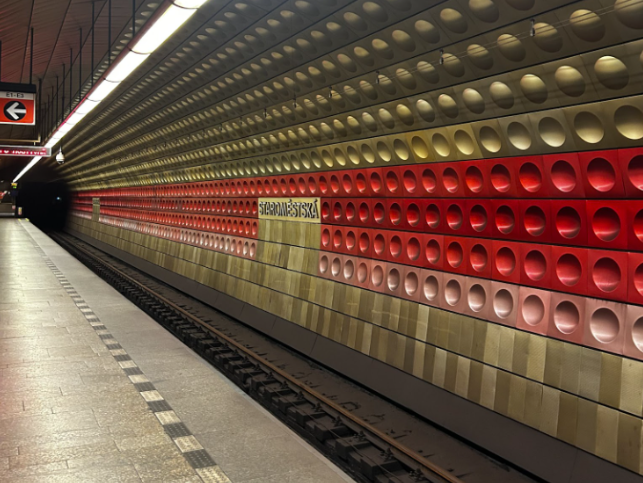
There is something slightly absurd about spending two months in Prague, surrounded by Gothic cathedrals, Baroque castles, and streets older than the United States itself, and the highlight of my summer somehow being…public transportation. Yet of everything that impressed me during my summer in the Czech capital, nothing quite compared to the city’s metro.
Prague is, by almost every measure, a remarkable city. Most of its historic architecture survived the twentieth century’s world wars, leaving centuries of history visible on nearly every street. Its landscape is notoriously hilly, and the Vltava River winds through its 10 major districts, both of which make the city geographically fascinating. And beneath Prague’s cobblestone streets and richly antiquated and fragile architecture, its volatile riverbanks and its tiringly inconvenient hills, lies an impressively modern transportation network that makes navigating the city remarkably easy.
Three underground metro lines connect major transit hubs, while an extensive network of trams and buses reaches practically every corner of the city. Trains arrive every 3–5 minutes during rush hour, and night services keep the city connected long after the metro closes. For the two months of my residency, I rarely found myself waiting long for a connection, let alone needing to order a Bolt (a popular European rideshare service, Uber-adjacent).
The most astonishing part of it all was the price. As a student working an unfortunately unpaid internship, I paid just 550 Czech koruna, approximately 25 USD, for an unlimited monthly transit pass. For less than the cost of half a tank of gas back home, I could commute to work, explore unfamiliar neighborhoods, and navigate a major European capital without ever worrying about parking or paying for gas.
I hail from the San Francisco Bay Area, a region already known for its substantial public transit networks that excel in comparison to the rest of America. Moving to Westwood for college and going from the convenience of the BART, CalTrain, and Muni to the objective train wreck (pun intended) that the LA transit system sometimes emulates was already quite the culture shock. In both urban areas, however, owning a car feels like an obvious prerequisite for getting anywhere efficiently and without 17 different transfers. Prague, on the other hand, offered a glimpse of an entirely different relationship between cities and the people moving through them.
Of course, Europe’s extensive public transportation networks aren’t exactly a secret. What surprised me most of all was how thoroughly public transit seemed to be integrated into everyday life. Instead of merely providing cheap transportation for those without cars, Prague’s system offered an exponentially more convenient alternative to driving.
This distinction reflects a larger difference in how European and American governments approach transportation. Throughout much of Europe, public transit has developed alongside national and international efforts to improve regional connectivity. The European Union’s Trans-European Transport Network, for instance, coordinates the development of railways, roads, waterways, and urban transportation links across member states, facilitating cross-border travel and trade. Under regulations revised in 2024, 431 designated urban hubs must adopt sustainable mobility plans by the end of 2027.
While Prague’s transit system predates these policies, the EU’s approach illustrates how transportation has become intertwined with large-scale discussions of international economic integration, environmental sustainability, and regional development. Mobility is no longer simply a question of getting residents to work, but part of a larger effort to connect cities, economies, and countries.
Meanwhile, the American experience has followed a starkly different trajectory.
Los Angeles, ironically, once boasted an extensive electric railway network of its own. In the early twentieth century, the Pacific Electric Railway’s famous Red Cars connected communities across Southern California, long before the region became synonymous with freeways and traffic congestion. Unfortunately, automobile ownership, suburban expansion, and changing investment priorities contributed to the system’s eventual decline.
The Federal-Aid Highway Act of 1956 accelerated America’s transformation, establishing federal funding for 90% of interstate highway construction costs. The resulting expansion of highways facilitated suburban development, but it also reinforced a model in which residential communities, workplaces, and commercial centers became increasingly separated.
Today, Los Angeles is attempting to reverse some of this legacy. In May 2026, three new Metro D line stations opened, contributing to a 62% increase in ridership on that line compared with the previous May. But even as LA expands its rail network, decades of automobile-oriented development make creating convenient transit connections considerably more complicated.
The San Francisco Bay Area presents another contradiction. Unlike LA, the region has long operated an extensive rapid transit network through BART. However, the system now faces a $350 million to $400 million annual structural deficit, threatening its long-term financial sustainability.
BART’s predicament is a sinking ship anchored to changing American work culture. Before the COVID-19 pandemic, passenger fares and parking fees covered nearly 70% of operating costs. As remote work reduced the number of daily commuters, the system lost much of the revenue upon which it had historically depended. By fiscal year 2026, BART’s operating revenue ratio had fallen to approximately 32%.
This, naturally, raises again an age-old question about the relationship between transportation and the economy. If a public transit system depends so heavily on people commuting to offices five days a week, what happens when the way people work fundamentally changes? BART’s financial crisis reveals the vulnerability of a funding model much too closely connected to commuter behavior.
Prague, on the other hand, provides an interesting comparison. In 2024, passenger fares covered just 17.5% of its public transportation operating costs, while municipal subsidies accounted for approximately 81.4%. Prague’s system is not inexpensive to operate; rather, its affordable fares are made possible through substantial public investment, reflecting a far different understanding of transportation’s economic value.
This difference matters well beyond the price of a ticket or a monthly transit pass. According to AAA, owning and operating a new vehicle costs an average of $12,863 annually in the United States. Although actual costs vary considerably, Americans living in automobile-dependent communities often have little choice but to absorb the tough expense of private transportation. Meanwhile, dependence on private vehicles has undeniable implications for international energy markets and climate policy.
European efforts to strengthen sustainable mobility are part and parcel of bigger regional initiatives for reducing emissions and improving economic resilience. But in the United States, the limited availability of transportation alternatives continues to make everyday mobility closely dependent on automobile ownership and energy prices.
Admittedly, Prague and California are hardly perfect comparisons. Prague’s compact urban core and historical development have made high-frequency transit more practical than in many sprawling American population centers. European cities also vary enormously in transit accessibility and affordability, and extensive transport subsidies mean making difficult budget decisions. Nevertheless, the contrast between these three parts of the world should have us wondering about what governments ultimately expect public transportation to accomplish. Is it a service whose success should be determined primarily by ridership and revenue? Or is public transportation an essential public investment whose value extends to and even past the accessibility and economic opportunities it creates?
The answer, I would argue, lies in recognizing that the economic value of public transportation cannot be reduced to the money collected at the turnstiles. We readily accept that highways require substantial public investment because they do important things like facilitate commerce, connect communities, and support economic development. And yet, public transportation is so often scrutinized through the narrower lens of fares, ridership, and operating deficits, as if its benefits start and end solely with those who purchase a ticket. BART’s financial struggles and Prague’s substantial subsidies are stark examples of two different approaches to a service with a value that extends much beyond its immediate users.
These aren’t just questions for city planners or local transportation authorities. In an increasingly interconnected global economy, the infrastructure that moves people truly is inseparable from the infrastructure that moves economies. Europe’s efforts to coordinate transportation across national borders showcase their understanding that regional connectivity is essential to long-term economic integration and competitiveness. Meanwhile, America’s continued reliance on private automobiles leaves households exposed to fluctuations in international energy markets, while limiting the alternatives available when those prices inevitably rise and continue rising. The way that we choose to get around our cities, it turns out, has consequences that extend rather far past them. In essence, increasing public transportation has implications for interconnectedness beyond the interpersonal domain.
No, throwing money at public transportation won’t magically transform Los Angeles into Prague. Improving American transit will, naturally, require difficult decisions about housing density, infrastructure development, service frequency, and public spending. But these challenges shouldn’t become excuses for sitting aside and accepting the status quo, particularly when that status quo is in itself the product of decades of deliberate policy decisions. If American governments could invest so extensively in building the automobile-dependent communities we inhabit today, surely we can at least entertain the vague possibility of investing in alternatives.
I certainly didn’t go to Prague expecting to return with particularly robust opinions about municipal transportation budgets. But two months of experiencing a city where public transit was both affordable and genuinely convenient made me question just how much of America’s transportation predicament is truly unavoidable.
Perhaps we’ve spent so long adapting our lives to the limitations of our infrastructure that we’ve forgotten those limitations were never inevitable in the first place. And if there’s one thing I took away from my summer abroad, it’s that the way things have always been done is hardly ever a convincing argument for the way they ought to be done.
Image source: Nithila Chintakindi


